The concern most often voiced in destination marketing is that AI assistants will sit between the traveller and the destination, absorbing the planning journey and leaving official channels stranded. Survey data from the United States, the largest source market for every Commonwealth Caribbean destination, indicates the opposite is happening at this stage.
What the data shows
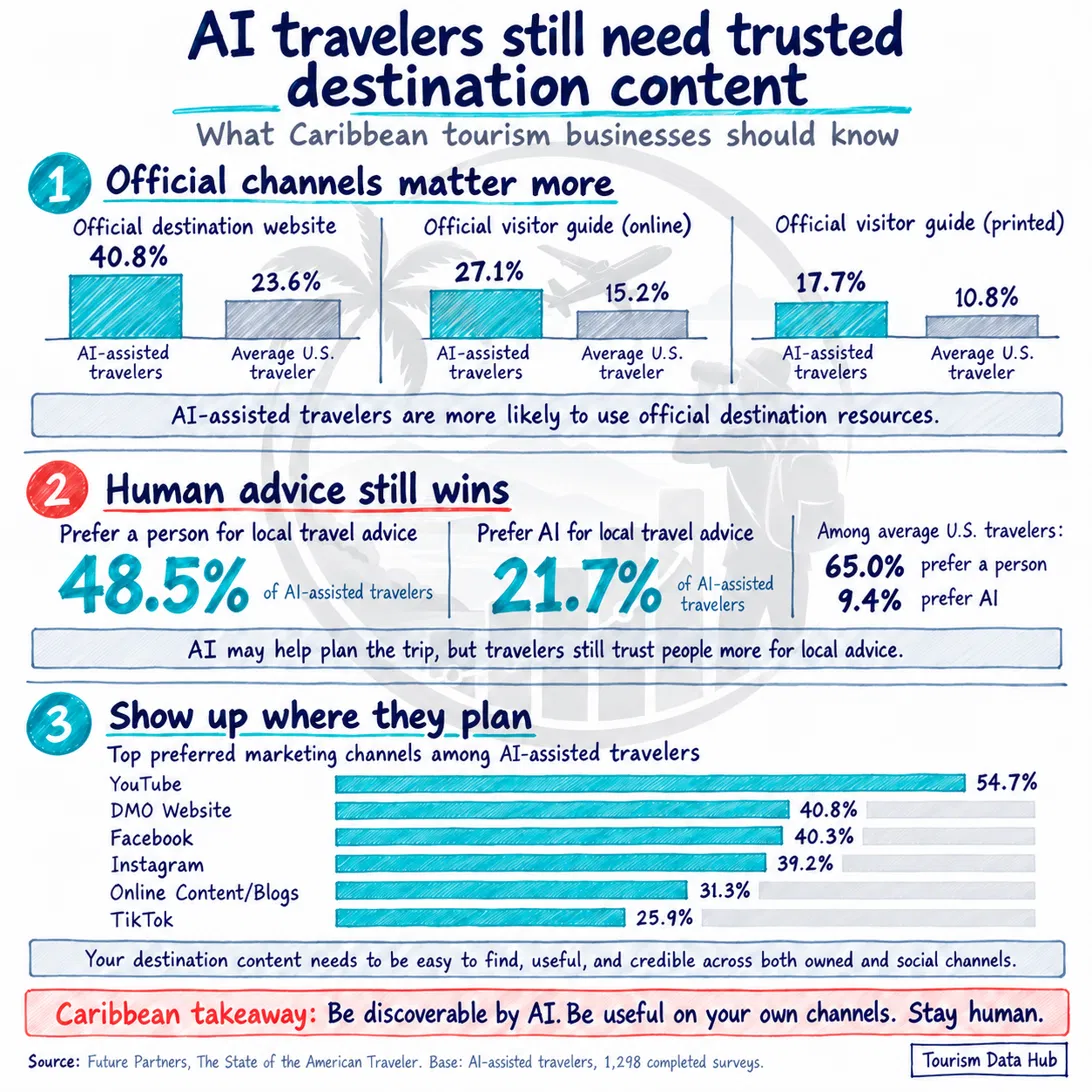
Among the respondents who reported using AI to help plan travel, a base of 1,298 completed surveys in Future Partners' State of the American Traveler, 40.8 per cent said they use official destination websites, against 23.6 per cent of the average US traveller. The same pattern holds for the other official channels measured.
| Channel | AI-assisted, % | Average traveller, % | Difference, pp |
|---|---|---|---|
| Official destination website | 40.8 | 23.6 | +17.2 |
| Official visitor guide, online | 27.1 | 15.2 | +11.9 |
| Official visitor guide, printed | 17.7 | 10.8 | +6.9 |
Asked who they would prefer for local travel advice, 48.5 per cent of the AI-assisted respondents chose a person and 21.7 per cent chose AI. Among average US travellers the preference for a person is stronger still, at 65.0 per cent against 9.4 per cent.
On preferred marketing channels, the AI-assisted respondents named YouTube most frequently at 54.7 per cent, followed by destination marketing organisation websites at 40.8 per cent, Facebook at 40.3 per cent, Instagram at 39.2 per cent, online content and blogs at 31.3 per cent, and TikTok at 25.9 per cent.
A separate study, conducted in April 2026 by MMGY Intelligence with Sabre, Sojern and Mindtrip, surveyed 1,006 US leisure travellers and 103 US destination marketers. Among the traveller respondents, 54 per cent reported having already used AI to plan a trip and 75 per cent intended to use it again. Among the destination marketer respondents, 70 per cent reported declines in organic search traffic which they attribute to AI-powered search results.
What may be driving it
The two datasets appear to describe a sequence rather than a contradiction. Fewer travellers may be arriving at a destination website through a conventional search result, while those who do arrive, having been pointed there by an assistant, appear to be a higher-intent group than the traffic that preceded them.
One reasonable interpretation is that an assistant surfaces a name, a neighbourhood or an activity, and the traveller then seeks confirmation from a source they consider authoritative. On that reading AI generates the question, and the destination is still expected to answer it.
Part of the gap is likely to reflect planning intensity as well as AI itself, since travellers who adopt these tools tend to be more engaged planners in general. The direction holds either way, and it runs opposite to the prevailing assumption.
The exposure is not that AI removes the destination from the journey. It is that the destination may not be saying anything the assistant can find, trust or repeat accurately.
That distinction matters more for this region than for larger markets. Retrieval-based discovery depends on whether current, specific and structured information about a destination exists in a form these systems can draw on. Commonwealth Caribbean destinations are comparatively weak on that supply: fragmented small-property inventory, limited connectivity among independent operators, thin machine-readable public data, and official content that is frequently promotional in register rather than factual.
For small and multi-island markets there is a further risk that is difficult to detect. Systems drawing on generic or outdated material may conflate neighbouring destinations, default to a resort framing that does not describe every market, or surface stale advisories and price points. Unlike a poorly placed advertisement, an error of that kind is neither easy to see nor straightforward to correct.
What it means in practice
A fall in organic sessions is not by itself evidence of lost relevance, and managing it as though it were may lead to the wrong response. It may be a change in the composition of arriving traffic, and it can only be distinguished from genuine decline by examining what that traffic does after it lands. Session volume, referral source and on-site behaviour over the past 18 to 24 months will show whether engagement per visit has held or improved while volume fell. Most tourism authorities already hold this data.
The second implication concerns what the official website is for. Opening hours, access routes, seasonality, costs, transport options and safety guidance are what a traveller arrives to verify. Material that inspires but is thin on specifics does not answer the question the assistant has prompted, and is also the material least likely to be retrieved.
The third is an opportunity rather than a threat. Discovery through paid search and social media rewards budget, and destinations in this region are structurally outspent. Retrieval rewards the accuracy, specificity and currency of published information, which is comparatively inexpensive to produce. That advantage would accrue only to destinations treating authoritative content and open data as infrastructure rather than as marketing collateral.
Two practical steps follow, both low cost. Running a consistent set of prompts about the destination across the major AI systems, and recording what is surfaced, what is inaccurate and what is omitted, produces primary evidence that no aggregate report currently provides. And adding two items to an existing exit or visitor survey, covering how the visitor first heard of the destination and which sources were used to plan, each with an explicit AI assistant option, would establish a local baseline. Without one, any future claim about AI-driven demand in the region will rest on assertion rather than measurement.
The human finding deserves equal weight. Even among the group most exposed to the technology, a person remains the preferred source of local advice by a margin of more than two to one. Comfort with AI for planning a trip has not translated into comfort with AI for advice on the ground. For a region whose product is disproportionately delivered by people, that appears to be a durable position rather than a consolation.