
Trinidad and Tobago welcomed 184,370 stopover visitors in the first six months of this year, down from 189,428 a year earlier, according to the Central Statistical Office. Stopover visitors stay at least one night, unlike cruise passengers who come ashore for the day. The decline was 2.7 per cent.
On its own, that suggests a tourism market broadly treading water. But the national figure obscures what is happening on each island.
Aviation data from OAG, the airline schedules company, shows that international air passengers arriving at Trinidad’s Piarco airport in the first half of this year were 5.7 per cent below their 2019 level. At Tobago’s Crown Point airport, they were 41.2 per cent lower.
One island has come close to recovering its pre-pandemic international passenger traffic. The other remains more than 40 per cent below it.
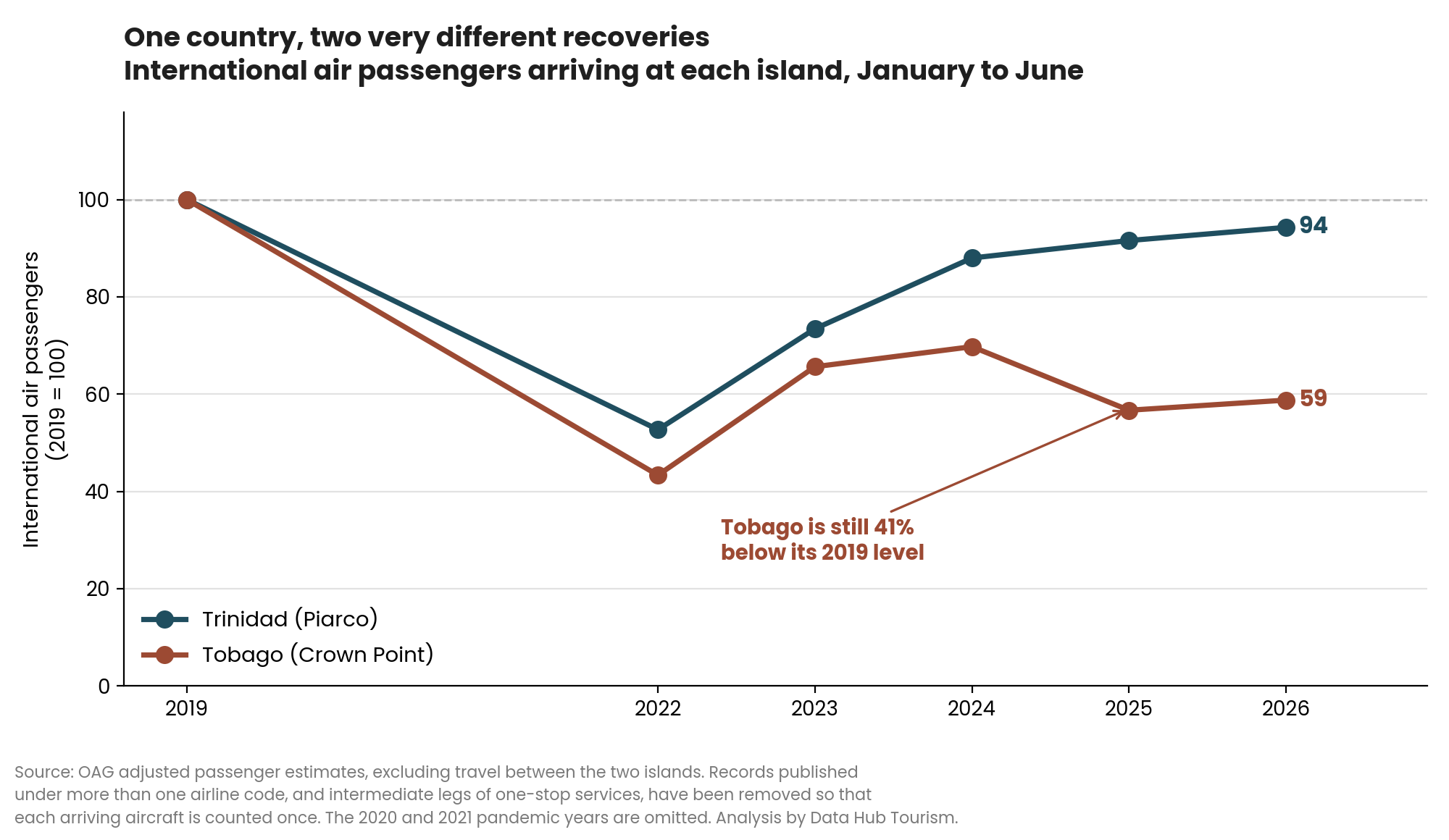
The national number hides Tobago
Of the 184,370 stopover visitors recorded in the first half of this year, Trinidad received 177,667. Tobago received 6,703. That gives Tobago just 3.6 per cent of the national total.
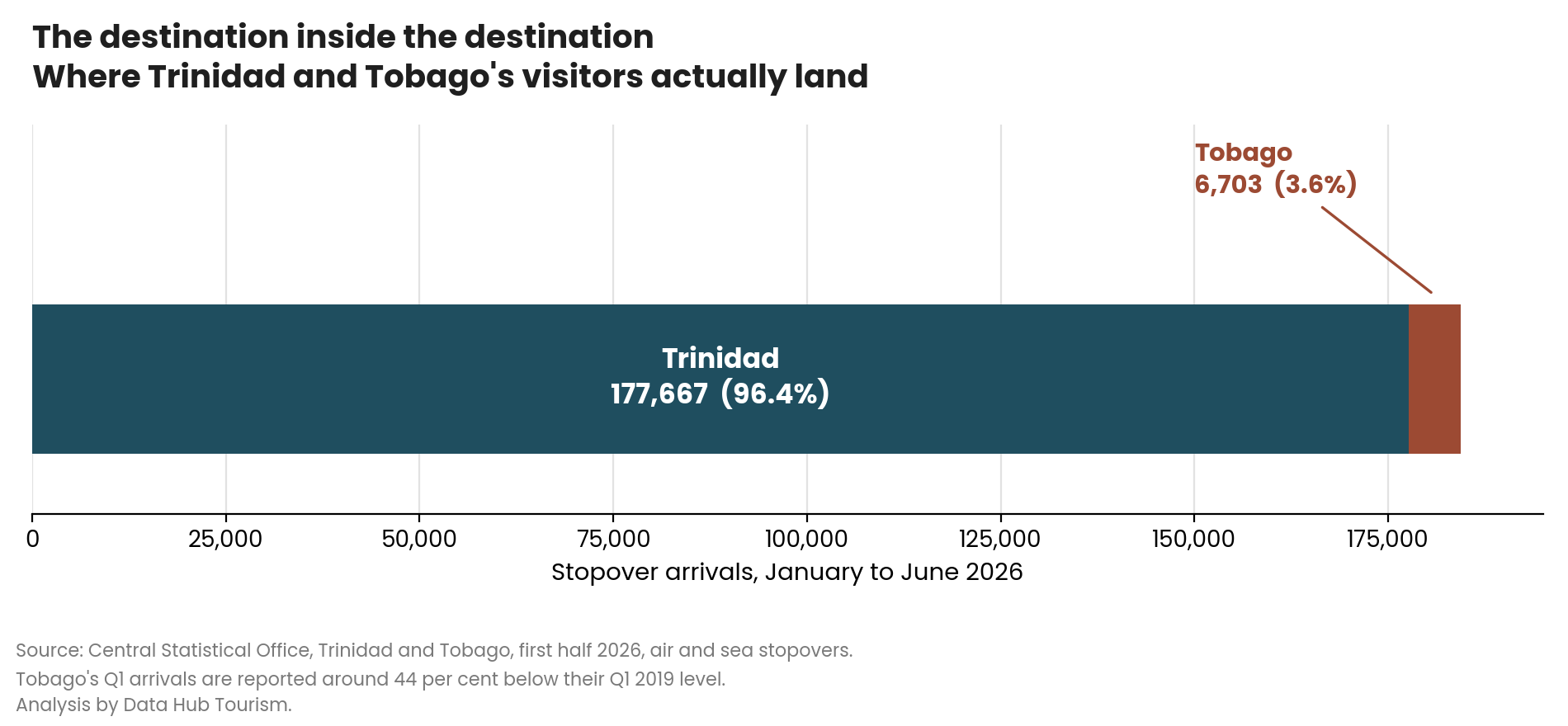
When one island accounts for more than 96 per cent of arrivals, even a severe contraction in the smaller market has little effect on the headline number.
The islands are also different tourism markets, not simply different-sized versions of the same one. Trinidad attracts substantial business and conference travel, alongside Trinidadians living abroad who return through Piarco. Tobago is the country’s principal leisure destination, built around beaches, diving and resort tourism. They serve different travellers for different reasons, yet their performance is ordinarily presented as one.
There is other evidence pointing in the same direction. A First Citizens Group research note published in June found Tobago’s first-quarter arrivals about 44 per cent below their first-quarter 2019 level. OAG’s passenger estimates, produced independently from aviation data rather than immigration records, put the first-half decline at 41.2 per cent.
Different sources and different methods arrive at essentially the same conclusion: Tobago’s international visitor market remains roughly 40 per cent smaller than it was before the pandemic.
That reality is difficult to see in the national figures.
Airlift tells two different stories
It is tempting to conclude that Tobago lost visitors because it lost flights. The evidence is more complicated.
International seat capacity to Tobago fell 42.1 per cent between the first half of 2019 and the same period this year, from 41,942 seats to 24,292. Passenger traffic fell 41.2 per cent over the same period. Aircraft were about 55 per cent full in 2019 and 56 per cent full this year.
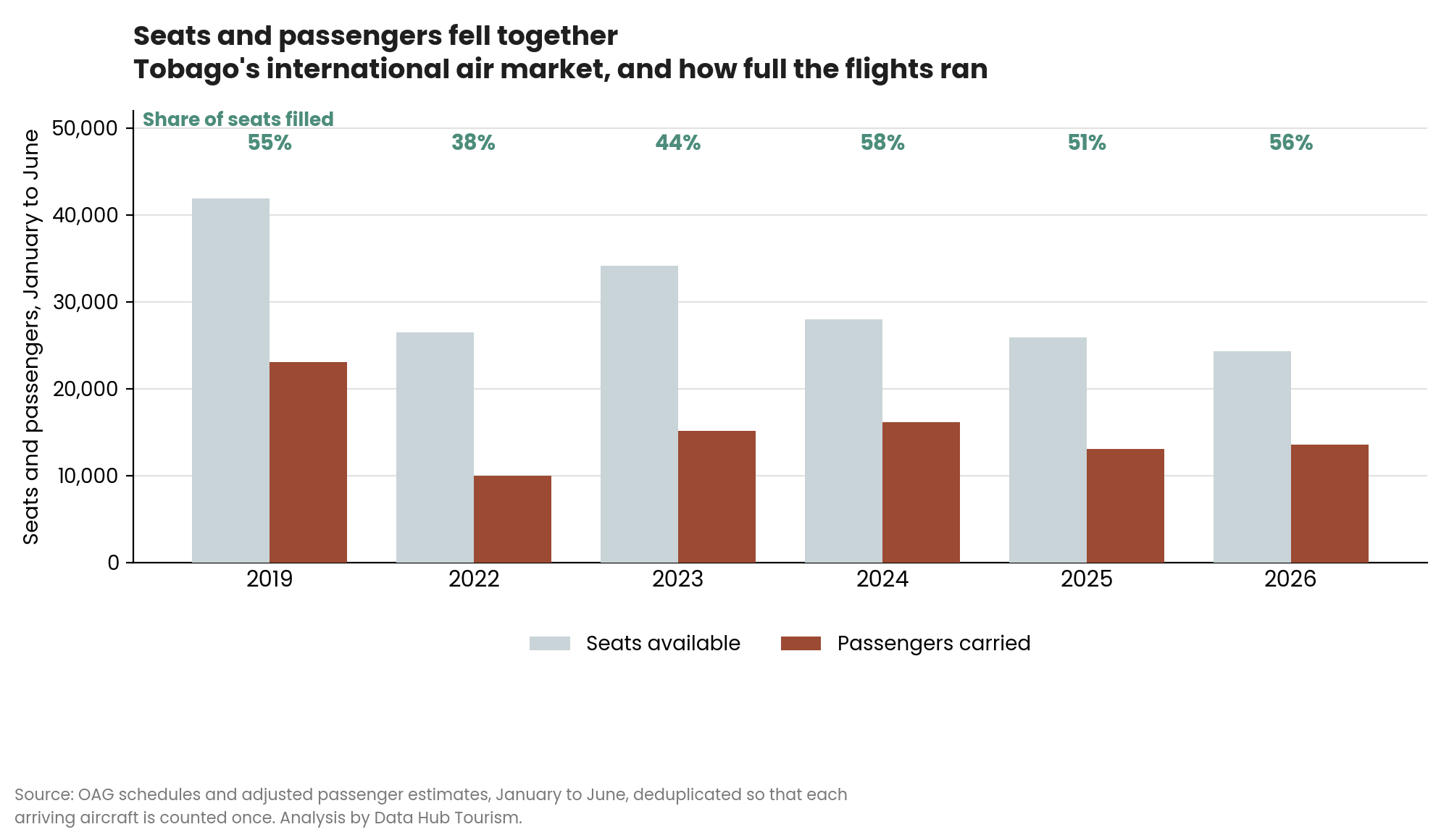
That does not suggest a large pool of travellers trying and failing to reach Tobago because seats are unavailable. International capacity has contracted at roughly the same pace as passenger demand.
The network through which any recovery would have to occur, however, has become narrower. In 2019, five international services connected Tobago with overseas markets. British Airways, with Iberia, flew from London Gatwick via Antigua. Virgin Atlantic flew from Gatwick via St Lucia. Condor served Frankfurt, Caribbean Airlines served New York, and another service operated from Manchester.
Today there are four. One London service remains, operated by British Airways with Qatar Airways via St Lucia. Manchester has disappeared. Antigua has disappeared. Combined London capacity across the former services is down 54 per cent. The one route added since 2019, a direct Caribbean Airlines service from Barbados, was discontinued on 2 September.
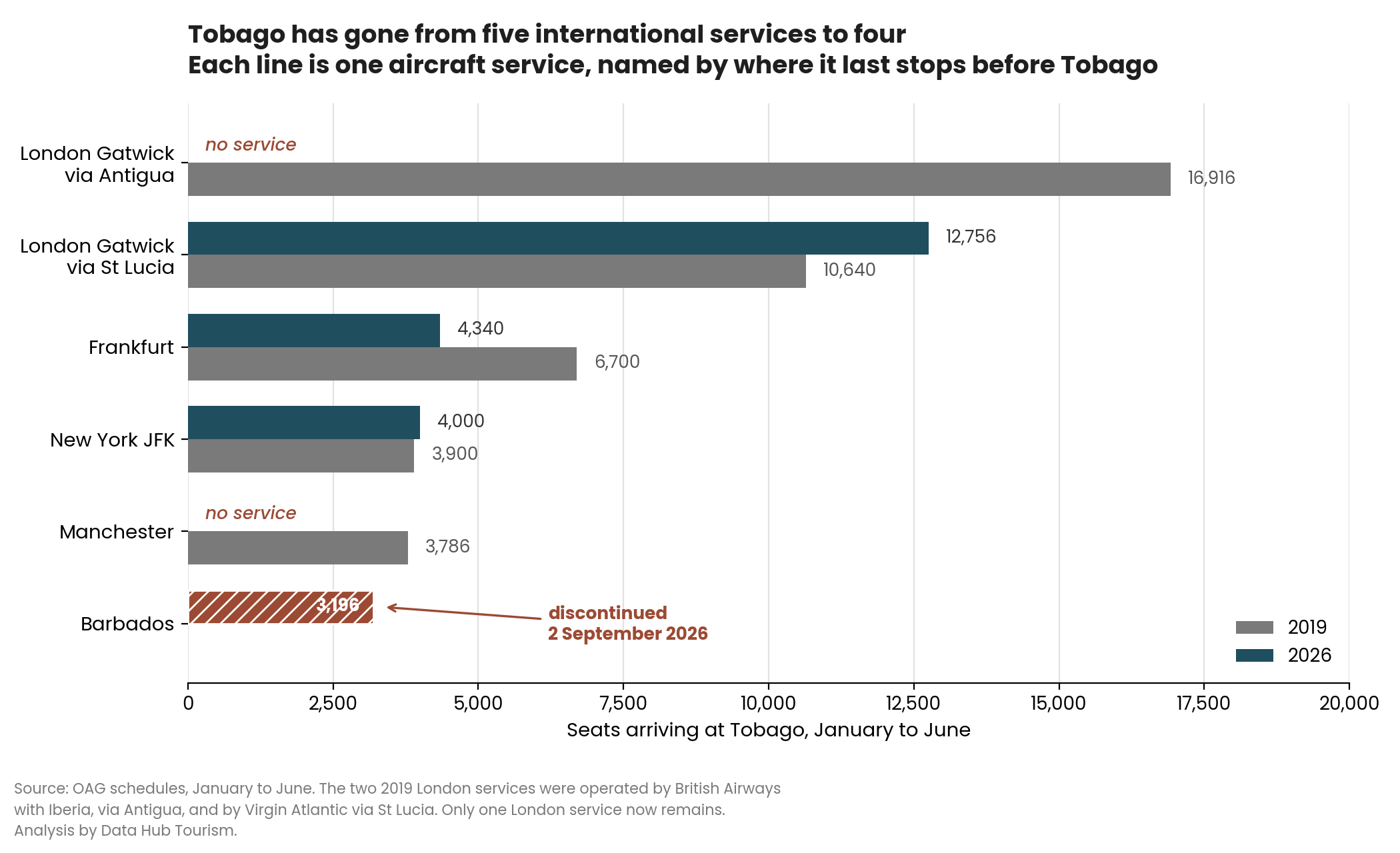
The international data points to a demand problem rather than a seat shortage. What it does show is an island left with a smaller and less diverse network through which to rebuild that demand.
The domestic air bridge presents a different picture.
OAG recorded 190,756 scheduled seats from Piarco to Tobago in the first half of this year, compared with 275,144 during the same period in 2019, a reduction of about 31 per cent. The route has operated at about 85 per cent full every year since 2022, compared with 67 per cent in 2019.
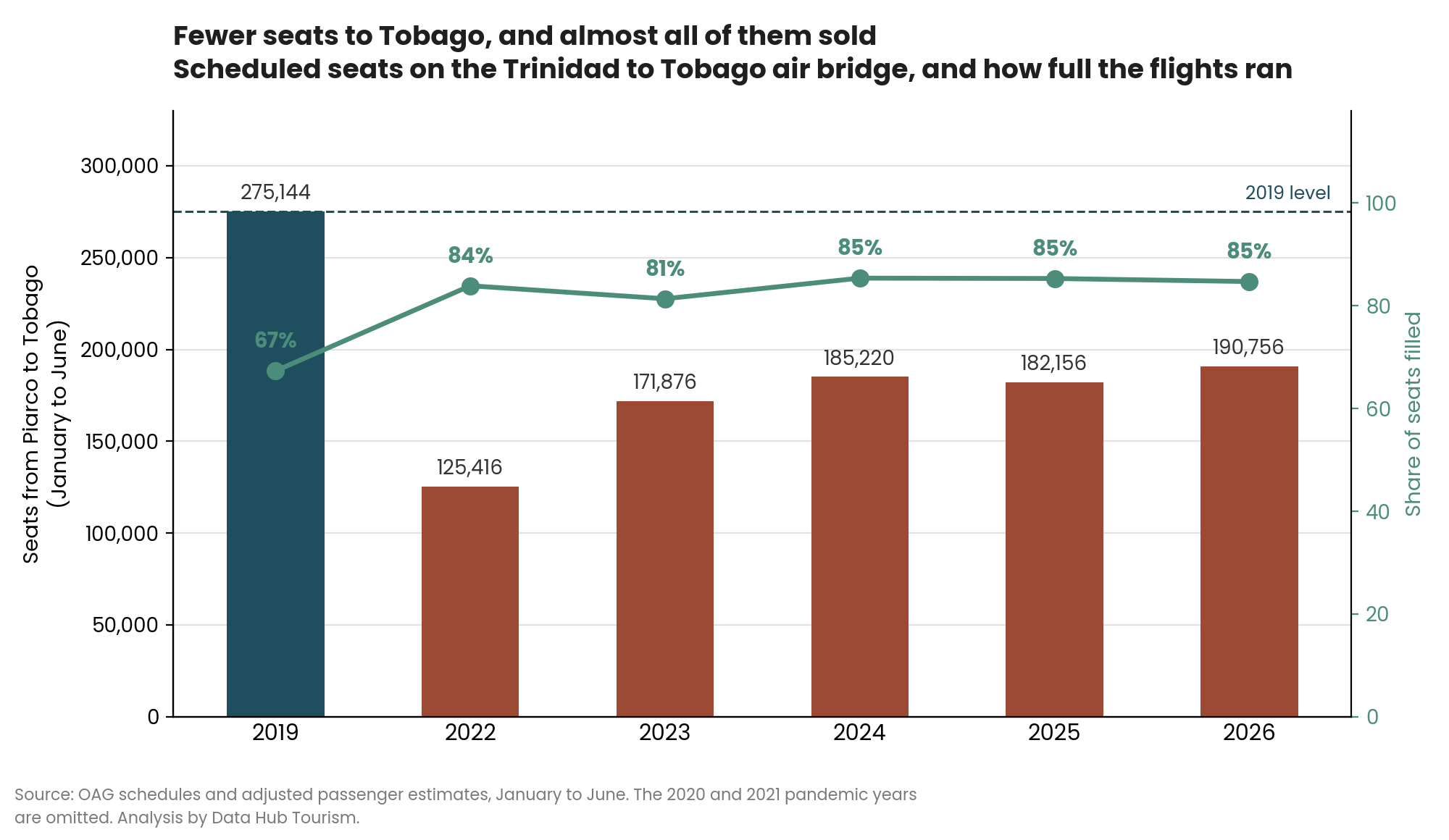
Sustaining that level of occupancy over four years leaves considerably less room to absorb surges in demand, particularly around weekends and holidays.
Internationally, capacity and passengers have fallen together. Domestically, capacity has fallen sharply while the remaining seats have stayed persistently full.
That is much closer to what an actual capacity constraint looks like.
A shrinking regional network
The loss of Tobago’s direct Barbados service also sits within a broader regional retrenchment by Caribbean Airlines.
The airline has reduced or discontinued at least seven regional routes since late 2025 after combined losses of approximately US$18.84 million on the affected services, according to figures provided to legislators and reported across the region. The Jamaica–Fort Lauderdale service ended in November 2025, followed by Trinidad–Puerto Rico in January. Further reductions followed around June as the airline withdrew from several Eastern Caribbean services and reduced frequencies elsewhere.
A Route Oversight Committee established by the airline in 2025 concluded that several routes introduced during its 2023 Eastern Caribbean expansion lacked adequate commercial justification from the outset.
Caribbean Airlines has said connectivity among Trinidad, Tobago and Barbados will continue through other scheduled services. The direct Piarco–Barbados flights remain. Barbados therefore retains its link to Trinidad; Tobago loses its direct connection and must instead connect through Piarco.
That exposes a broader policy tension. Tobago depends heavily on a single state-owned carrier for its domestic air bridge and part of its regional connectivity. Caribbean Airlines, meanwhile, has been withdrawing from routes that do not meet its commercial requirements.
From an airline’s perspective, that can be entirely rational. A carrier earns its return from the passenger in the seat. Much of the wider economic value of that passenger accrues elsewhere, to the hotel, restaurant, tour operator or taxi driver.
What is commercially rational for an airline is not necessarily a tourism-development strategy.
The published record does not make clear how, or whether, those two objectives are being weighed against each other.
The blind spot extends beyond arrivals
The weakness in the national picture is not confined to stopover visitors.
Trinidad and Tobago received 35,278 cruise visitors between January and April this year, compared with 48,908 during the same four months of 2025, a decline of 27.9 per cent. Every month was down by double digits. But those figures are national, so they do not establish how much of the deterioration occurred in Tobago.
The hotel data presents much the same problem. CoStar, which tracks hotel performance, reports on 71 properties representing 4,215 rooms across Trinidad and Tobago. Over the past 12 months, occupancy averaged 48.3 per cent, down 4.8 percentage points from the preceding 12 months. Average daily rates rose 2.5 per cent to US$187, while revenue per available room fell 6.7 per cent to US$90.
Hotels in the sample have charged more while selling fewer rooms, and the higher rates have not been enough to offset weaker occupancy.
But CoStar also treats Trinidad and Tobago as a single market. The published figures cannot show whether Tobago’s hotels are performing differently from those in Trinidad. Nor does CoStar publish occupancy or rate performance for the luxury and upper-upscale segments, which account for 2,175 rooms and roughly half the inventory it counts.
Arrivals, cruise traffic and hotel performance therefore share the same analytical limitation: the national picture cannot show clearly what is happening in Tobago.
Why the distinction matters
There is nothing unusual about reporting tourism statistics nationally. The problem arises when the aggregate becomes the principal number through which the industry is understood.
A 2.7 per cent decline describes a market that may require watching. A tourism market still roughly 40 per cent below its pre-pandemic level six years later presents a different problem. It raises different questions about route economics, airline incentives, the reliability and cost of the domestic connection, and the ease with which travellers from major source markets can reach Tobago.
For a guesthouse in Crown Point, a dive operator in Speyside or a taxi driver in Scarborough, the difference between those two numbers is not an abstract statistical distinction. It changes the assessment of the market in which they operate.
The Central Statistical Office already collects an island-level breakdown. It exists in the underlying data. What is missing is the routine publication and discussion of Tobago as a tourism market in its own right.
There is also a question of timeliness. The official arrivals series used here stops in June. Airline schedule data extends through September.
Aviation data measures supply where arrivals data measures demand, so the two answer different questions. Aviation data has two advantages that matter here: it becomes available sooner, and it can be examined island by island.
For anyone trying to understand Tobago’s tourism economy in something approaching real time, that currently makes it one of the more useful sources available.
It should not have to be.